Les Ghjuvannali sont les "cathares" corse.
C'est une confrérie de franciscains dissidents, qui pris
naissance à Carbini en Alta Rocca au milieu du XIVe siècle et qui fut annéantie aprés une
cinquantaine d'années.
Ce mouvement mystique et non violent, animé par un frère pénitent franciscain fut
encouragé par les seigneurs Polo et Arrigo : fils cadets d'Arrigo Strambo d'Attalà et
petits-fils du célèbre Giudice.
Ils étaient dirigés par un frère franciscain, Giovanni Martini.
Comme celle des franciscains dont ils sont issus, leur doctrine sociale et religieuse était basée sur
la pauvreté et le don de soi. Les Ghjuvannali disaient que l'on ne devait pas avoir de biens propres et
que tout devait être mis en commun. En fait, ils n'ont pas de rapport avec le catharisme du
Sud-Ouest de la France mais peuvent être rattachés aux Fraticelles franciscains.
Dénonçant le faste des "puissants", ils refusaient de payer l'impôt mais aussi de se marier...
d'où une réputation imméritée de débauchés.
Ils s'étaient surtout développés dans le sud de l'île, la "Terra di i Signori" ( Terre des Seigneurs).
Ils eurent aussi un centre dans le Nord à Alesani.
Plutôt hostiles à la hiérarchie de l'église qui les jugeait à l'opposé du
message christique.
Leur spiritualité, leur sens religieux et social s'étaient alors répandus dans presque toute la Corse.
Vers 1352, l'évêque d'Aleria excommunie les adeptes de ce mouvement qui comptait alors une dizaine d'établissements
en Corse. A la fin de 1352 les Ghjuvannali en appelent à l'archevêque de Pise et obtiennent la levée de l'excommunication.
En 1354, avant de mourir, l'évêque d'Aleria, Monseigneur Raimondo, s'adresse au Pape Innocent VI. Il lui dit que
les Ghjuvannali sont des illuminés, superstitieux, hérétiques, schismatiques et irrespectueux envers
l'autorité épiscopale.
Innocent VI, se fiant aux dires de l'évêque, excommunie les Ghjuvannali avant de mourir.
Son successeur, Urbain V, un bénédictin, maintient l'excommunication et envoie un légat en Corse.
Ce légat, fort du soutien de nombreux seigneurs locaux, organise une sainte croisade militaire dans la région de
Carbini et en Corse orientale, au nom d'une Religion qui ordonne dans son 5ème commandement "tu ne tueras point".
De 1363 à 1364, à Carbini, Zevaco, Ghisoni, en Alesani... on massacrera 20 à 30 000 Ghjuvannali,
femmes et enfants compris.
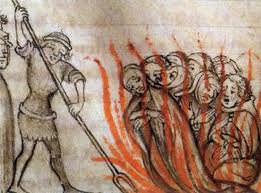
Certains, plutôt que de renoncer à leur foi, sont morts les armes à la main. Les derniers Ghjuvannali furent
brûlés à Ghisoni, au pied des montagnes appelées
Kyrie Eleison et Christe Eleison.
Adeptes de la non violence, la plupart des Ghjuvannali n'opposèrent aucune résistance, leur seule
alternative était la fuite ou la mort.
En ces temps de famine, de misère et de maladie, c'est une des plus sombres pages
de l'histoire de la Corse.
The Ghjuvannali are the Corsican "Cathars".
It's a brotherhood of Franciscan dissidents founded in Carbini in Alta Rocca in
the middle of the fourteenth century and which was destroyed after
some fifty years.
This mystical and non-violent movement, led by a penitent Franciscan brother,
was encouraged by the Lords Polo and Arrigo: younger sons of Arrigo Strambo Attalà and
grand son of the famous Giudice.
They were led by a Franciscan friar,
Giovanni Martini.
Like the Franciscans from which they originated, their social and religious doctrine was based on
poverty and self-sacrifice. The Ghjuvannali stated that they should not have to own property and
that everything must be shared.
In fact, they have no connection with the Cathars of the South-West of France but they
can be related to the Franciscan Fraticelli.
Denouncing the splendor of the "influential", they refused to pay tax and also refused to marry ...
which gave them the undeserved reputation of profligacy.
They were mainly developed in the south of the island, the "Terra di i Signori" (Lords of Earth), but
they also had a center in Alesani. (Haute-Corse)
They were rather hostile to the hierarchy of the Church which they considered to be the opposite
of the message of Christ.
Their spirituality, religious and social sense were prevalent throughout Corsica.
Towards 1352, the bishop of Aleria excommunicated followers of this movement which then had a dozen establishments in Corsica.
At the end of 1352 in the Ghjuvannali appealed to the archbishop of Pisa and obtained the lifting of the excommunication.
In 1354, before dying, the bishop of Aleria, Bishop Raimondo, addressed the Pope Innocent VI. He told him that the Ghjuvannali are
illuminated, superstitious, heretics, schismatics and disrespectful of episcopal authority.
Innocent VI, trusting the words of the bishop excommunicates the Ghjuvannali before dying.
His successor, Urban V, a Benedictine, maintains the excommunication and sends a legate to Corsica. This legate, substantially
supported by local lords, is organizing a holy military crusade in the region Carbini and Eastern Corsica, in the name of a
Religion that orders in its 5th commandment "thou shalt not kill". From 1363 to 1364, in Carbini, Zevaco, Ghisoni and Alesani ...
they massacred 20 to 30,000 Ghjuvannali, including women and children.
Some rather than renounce their faith, died with weapons in hand. The last Ghjuvannali were burned in Ghisoni, at the foot of
mountains called
Kyrie Eleison and Christe Eleison.
Followers of nonviolence, most Ghjuvannali offered no resistance, their only alternative was escape or death.
In these times of famine, poverty and disease this is one of the darkest pages in the history of Corsica.
leghje più in corsu
tempicorsica.com
close this window