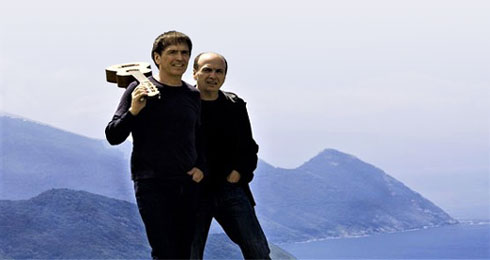
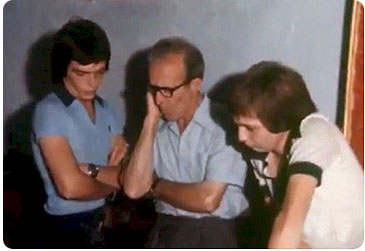
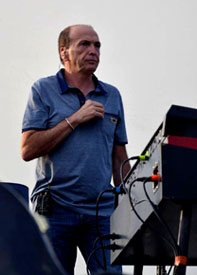
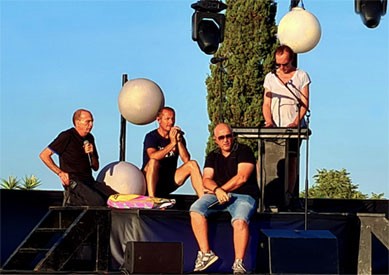
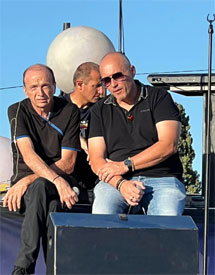
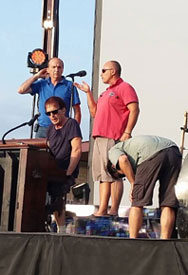
Jean-François and Alain Bernardini
were born in the small village of Tagliu-Isulaccia in the Castagniccia.
At a very early age they began to sing with their father, Ghjuliu, who was a great poet and singer. Ghjuliu (Jules) Bernardini, one of the core 'traditional'
singers from the village of Tagliu who features prominently in the field recordings of Quilici, Laade and others made between 1948 and 1973 and who
is still very much revered ( posthumously, Ghjuliu Bernardini died in december 1977 ) as one of the anchors of the tradition.
Shortly after the Aleria-drama Ghjuliu Bernardini wrote "Lettera à fratellu".
They recorded their first single with their father in collaboration with the
group "Canta u Populu Corsu".
"I Muvrini ... ti ringrazianu", their début album, released in 1979, was dedicated to their father's memory.

The early years of 1980 were difficult: some villages forbade the group to perform under the
pretext that they disrupted public order.
I Muvrini however, continued to sing in the Corsican language. They created their very own style by mixing traditional music
with their own compositions. The Corsican identity was placed at the heart of their sound. The title of I
Muvrini's second album 'Anu dà volta' was a reference to the Corsican political prisoners of the late 70's.
The public became more and more enchanted and came in great numbers to their
concerts. The group embarked on various events on the continent: Spring Festival of Bourges, Palma de Mallorca, Bretagne and Germany.
In their aim to preserve the musical heritage of their island they set up special music schools to teach
the children of Corsica about their musical and cultural heritage. The lovely album "Rundinella" was recorded with
the assistance of the children of these "scola aperta".
Their next album "E campa qui" was a big success and got a lot of airplay by local radiostations.
I Muvrini became the leading group of the Corsican music scene. The political message they
spread through their music and their commitment to local political life increased their
popularity. I Muvrini's concerts became major events, for Corsicans as well as for tourists.
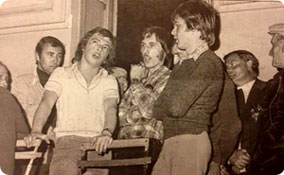
In 1985 "I Muvrini '85" was released, a year later "A l'Encre Rouge". The I Muvrini style was absolutely perfect on their album "Lacrime", which was an immediate success.
After the success of this album they created their own label: AGFB.
The fame of I Muvrini had now reached beyond their homeland; their polyphonic sound became a huge hit
throughout Europe.
"Pè l'amore di tè" ,recorded in Paris and released in 1988, proved enormously successful and sold
over 300.000 copies. The next album "Quorum" was recorded in Toulouse in 1989, followed by
their first live album "In Core" in 1990.
I Muvrini were also noticed by other musicians. They worked together with Jaques Dutronc, Michel Fugain, Veronique Sanson, MC Solaar,
Tina Arena, Sarah Brightman and Sting.
In 1993 they recorded their twelfth album "Noi", which contained the beautiful
traditional song "Lode di u sepolcru".
Highlight of the summer of '93 were the two concerts at Le Zénith in Paris.
See the text "A nostra Storia" which is on the CD Zenith 93 integrale, a text by G.Coanet, recited par
Jean-François BERNARDINI.
I Muvrini won the French music award Victoire de la Musique in 1998 and 2003, and was also nominated for the award in
2006. In 2005 they recorded ALMA (soul in Corsican), which was partly recorded in Johannesburg, South Africa, with Zulu choirs, and in 2007 "I Muvrini et les
500 choristes", which became their seventh French Gold Medal Record since 1994. The group has collaborated with internationally renowned artists, including
Sting (with whom Jean-François recorded a duet version of Sting’s “Fields of Gold”), Haris Alexiou, Nana Mouskouri, Ute Lemper, Angun, Tina Arena and Sarah Brightman. I Muvrini
has appeared at prestigious concert halls and festivals across North America and Europe. Their Alma tour in 2005 carried a message of peace containing
the Spanish proverb "If I had a thousand souls I would give them to you all. But I have only one, take it a thousand times."
I Muvrini remain ardent defenders of their island home, they seek to assert heritage.
As evidenced by the album Gioia released in 2010 and from celebrating thirty years of career.
Gioia ( joy ), recorded in studio ALMA includes the duet "Una Terranova" with
Grand Corps Malade, and welcomes Thomas Dutronc.
In 2012 the wonderful CD 'IMAGINÀ' was released. On this CD contemporary themes are addressed, themes that are dear to I Muvrini's heart,
such as environment, globalisation, and a very Corsican theme: political prisoners.
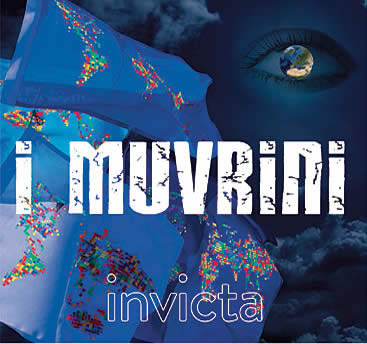
Latest CD 'INVICTA' released in march 2015 has the subtitle 'Music for Non-violence'.
music for non-violence
Invicta, le chant de la conscience jamais vaincue,
le chant des droits de l'âme...
Invicta tangles languages, cultures, instrumental colours. I Muvrini's Corsica is Celtic, South African, folk, trans, blues, gospel ...
Special was the friendship between I Muvrini and Dorothy Carrington (1910 - 2002), the
English historian who lived and worked in Corsica.
The road I Muvrini took was never an easy one, in spite of all the difficulties they remained faithful to
their background, their culture and their language.
Now, after more then 40 years, they are famous in and beyond Corsica. Yet, they have kept their integrity and their commitment.
And their message of brotherhood and solidarity shines through their music.
Ghjuliu Bernardini
Mieux qu 'une fée, c'est un poète qui s'est penché sur le berceau d'Alain et de Jean François Bernardini.
Ce poète, c'est Ghjuliu, leur père.
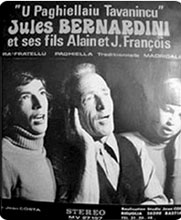 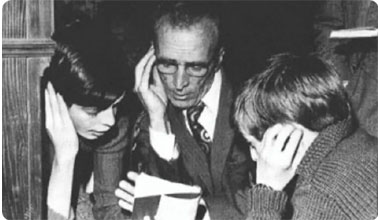 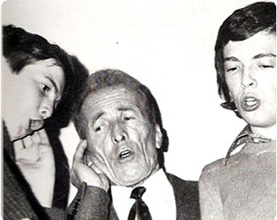
Ghjuliu Bernardini, est menuisier à Tagliu Isulacciu, mais c'est aussi un poête, et un chanteur d'exception de paghjelle.
N'est pas chanteur de paghjelle qui veut, il faut pour cela non seulement maîtriser le chant mais aussi la langue, les rimes, les vers et l'improvisation.
La dépendance est totale entre les mots et le chant. Avec Ghjuliu, chaque chant est un moment unique, à chaque fois surprenant, à chaque
fois différent, à chaque fois émouvant.
Les chants traditionnels sont perçus comme étant sauvages et comparés aux chants du sahara; la chanson corse pour le grand public,
est synonyme de romance Toscane ou Napolitaine.
Ghjuliu n'est pas influencé par cette mode des centres urbains, il apprend à ses enfants ce qu'il a appris de son père:
les véritables polyphonies corses.
Ghjuliu enrôle ses fils dans le combat pour les polyphonies, et dès l'âge de 10 ans Alain et Jean François se produisent
à la foire di u Niolu et à celle de la Restonica.
Alanu et Ghjuvan Francescu, chantent leurs premières paghjelle avec leur père en 1970, puis toujours encouragés par leur père,
ils collaborent avec le groupe Canta U Populu Corsu.
Arrive sur la scène insulaire le Fronte Paesasu Corsu di Liberazione (F.P.C.L.) José Stromboni, un bastiais de 36 ans,
militant connu et déjà interpellé une première fois en 1970 est déféré devant la Cour de Sûreté de l'Etat.
Stromboni sera tenu comme le chef du FPCL. Parallèlement Le Conseil des ministres annonce qu'il ordonne la dissolution du FPCL.
En 1974 Ghjuliu compose Letter'a à Fratellu, dédié à Stromboni.
Letter'a à Fratellu qui fut enregistré dans la maison familiale, connaît un immense succès.
Cette chanson donna le signal d'un renouveau de la véritable chanson corse.
Ghjuliu décède brutalement en 1977, il laisse en héritage à ses enfants tout son amour pour la poésie et pour les polyphonies.
En 1978, les deux frères reprennent le flambeau de leur père: Jean-François et Alain créent I Muvrini et marchent sur la
longue route de ceux qui "ont quelque chose non seulement à chanter, mais aussi à dire et des chemins à montrer "...
En chantant la terre corse, ils chantent toutes les terres du monde, conscients que la plus belle oeuvre d'un peuple, est sa langue, ils se donnent le
devoir non seulement de la vivre, mais aussi de la faire vivre... Ils chantent le Monde, les Hommes, la Fraternité, l'Amour et la Dignité.
Rien n'est acquis d'avance et le chemin sera laborieux ! Vexations, interdiction de concerts même en corse.... rien n'y fait, les deux frères
continuent le combat pour que survivent les polyphonies. Leurs armes seront, l'obstination, la persévérance, le travail et
la fidélité.
|
Every year I Muvrini dedicate a large part of their tour to Corsica, the 'Giru Corsu', meeting and talking with their
public, making the 'Giru' unforgettable for all concerned.
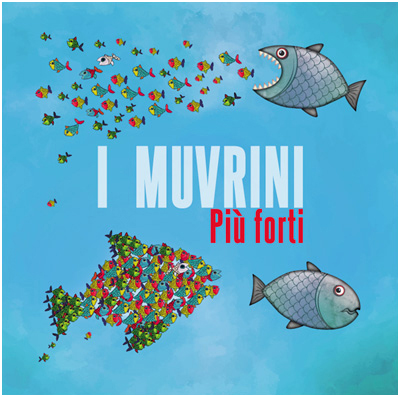
- 2022 release of the CD Più Forte
- 2021 release of Face u pane
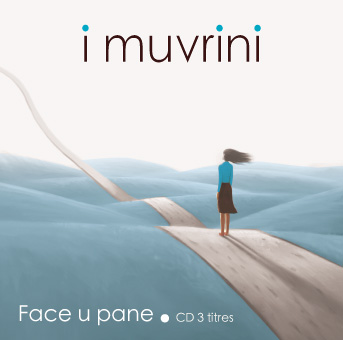
CD 3 titres
1. Face u pane
2. A panera
3. S'il te plaÎt papa
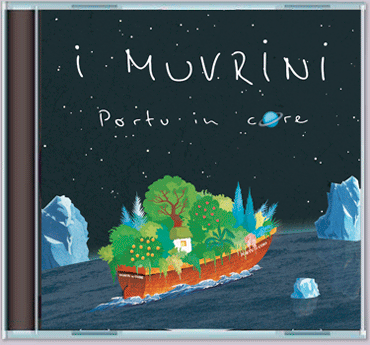
- 2019 release of Portu in Core
l'Autre enquête Corse Le trauma Corsica-France
Livret 175 pages see SHOP
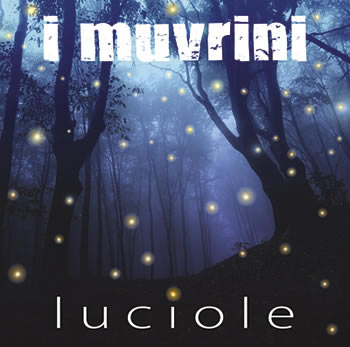
2017 release of Luciole
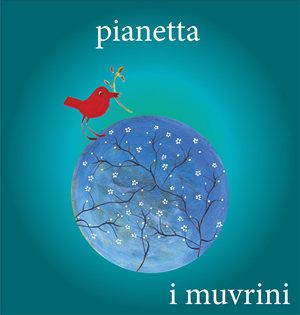
 2016: release of Pianetta
2015: Release of 'INVICTA' music for non-violence
Invicta, le chant de la conscience jamais vaincue,
le chant des droits de l'âme...
 2012: Release of 'IMAGINÀ'
see pictures of the presentation
2012: Release of 'IMAGINÀ'
see pictures of the presentation
 2011:Disque d'Or pour 'GIOIA'
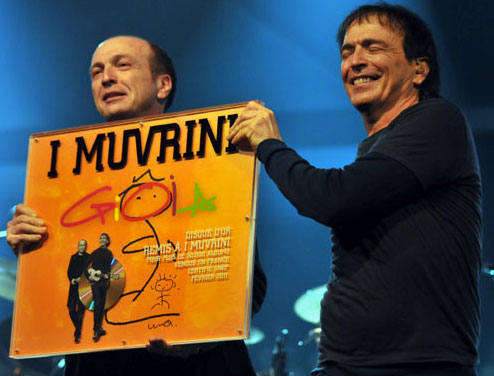 2010: Release of the album 'GIOIA'
- GIOIA Tour: concerts in the Netherlands, France, Suisse, Allemagne
2009: Very succesfull tour in the Netherlands and France
2008: Golden Record for "I Muvrini et les 500 choristes"
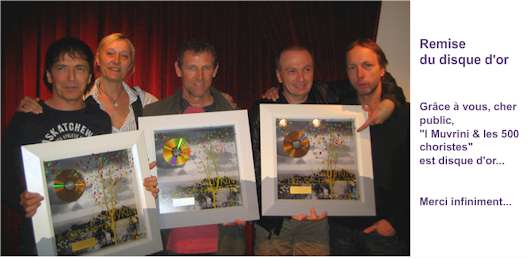 2007: 19 November Release of "I Muvrini et les 500 choristes"
2006: 20 November International release of the live DVD/CD Alma
2007: 19 November Release of "I Muvrini et les 500 choristes"
2006: 20 November International release of the live DVD/CD Alma
- 20 September national release of the new album "ALMA"
2005: Release of the new book "Carnet pour Sarah"
- Jean-François Bernardini elected "Man of the Year" by the readers of the Corse Matin
2004: Guest of honor at "La Nuit Celtique" March 2004
2003: "UMANI" won the Award best album of the year in the category WorldMusic at "Les Victoires de la Musique".
2002: Release of the album "Umani" in August, which resulted within a couple of weeks in a Golden Record.
- Presentation of the book UMANI by Jean-François Bernardini.
2001: Concerts in the USA, Germany and Poland.
2000: Release of "A Strada".
- Release of Jean-François' book "Lumière dans la tempête corse".
1999: Two exceptional concerts in Paris; in l'Olympia and le Zénith, followed by a European tour.
1998: Release of "Leia" and another Gold Disc
- Concerts at Bercy Stadium
1996: "Bercy" 27th January, where Jean-François spoke the now famous words
NE FERMEZ PAS LA PORTE
1996: "Curagiu" voted Best Traditional Music Album of the Year at the "Victoires de la Musique" awards
1995: Gold Disc for "Curagiu"
1993 : Release of Zenith live and NOI
1991 : Release of A Voce Rivolta
1990 : Release of In Core live
1989 : Release of Quorum
1988 : Release of Pè l'amore di tè
1987 : Release of A l'encre rouge
1987 : Release of A l'encre rouge
1985 : Release of I Muvrini '85 and Lacrime
1984 : Release of E campà quì
1981 : Release of Rundinella
1980 : Release of Anu Da Vulta
1980 : Release of Anu Da Vulta and Campemucci
1979 : Release of their first album Ti Ringrazianu, a tribute to their father Ghjuliu Bernardini
Of special interest to I Muvrini:
|
En mémoire à leur père Ghjuliu, Alain et Jean-François
Bernardini ont mis en place un studio d'enregistrement son et vidéo
au village de Tagliu-Isulaccia, leur village.
Ils mettent ainsi l'expérience du groupe I Muvrini au service des
artistes insulaires. Pour Alain Bernardini: " il s'agit de faire vivre
le rural tout en permettant aux groupes et chanteurs corses d'enregistrer
et de mixer leur créations sur leur terre" .
Le studio répond au nom de "Alma", un éponyme du
l'album d'I Muvrini, et inclut tous les moyens modernes actuels tout en
restant très convivial et intégré à l'espace
environnant. |
|
|